| Learning from Case Study # 1 |
| Meet Mark and Susan, understand their situation, walk through their decision-making process. |
| The photo below is a perfect depiction of how Mark feels as he explores early retirement! |
 |
| Mark announces early retirement by end of 2024 |
|
|
I have been fortunate to work with multiple generations of family members within the same families, which has been a great and an enriching thing in my life. That experience applies here.
|
|
When you see words in the middle of a paragraph italicized that means I am sharing my personal thoughts or an observation. When you see this computer, coffee and pen box or a personal photo of me, to the left that means I am choosing to get more seriously sidetracked to teach or review financial planning principles with you the audience. I am trying to carve out that information from the main theme of the case study, when I think it needs to be understood; to keep up with me on the case study.
|
I first learned about Mark when he was 19 years old (but just on paperwork involving beneficiary designation coded FBO of Mark along with three other siblings). I have enjoyed working with Mark’s parents as one of my favorite clients, for over forty years. He just lost his mother in September. I did not have the pleasure of meeting Mark in person until January of 2020 just before covid. That’s when I started helping him and his charming wife Susan with their finances. Mark just turned 60 years old, and Susan is 61 years old. They both have grown children and some grandchildren too. They have put together a very comfortable life for themselves, including some expensive hobbies and have goals, objectives and plans during their retirement. Those start out with their recent purchase of a use 1977 Grumman AGFB-5b Tiger airplane with only 1600 hours on if for $80,000, with a loan against it, with a payment of about $400.00 a month, that they just agreed to pay off with savings. Their goal of course is to enjoy several cross-country flights a year in retirement with the plane. I still have my Bose headset and handheld VHF radio, and I hope to get to use it by being invited for some local flights. They have allocated or wish to budget $10,000.00 a year to cover the expenses of those fun flights. (So right there that is $833.33 a month in our budget nut we must cover with retirement income, well, we will see how that works for them.) They are 100% committed to keeping their current home (not downsizing) and maintaining its mortgage and its payment. Most important, in addition to the new plane and its fuel and annual expenses. They are committed to at least maintaining their current standard of living throughout their retirement. Keep in mind that this standard of living was established with a two professional income working family.
|
|
Ten years ago, when planning for retirement we always factored in what we planners called, “Income Replacement Ratios, i.e. 70%.” This was a calculated reduction in income and lifestyle during retirement. That concept went out of date like the 8-track tape player. Today none of my successful clients are interested in any reduction in their lifestyles, some even what them enhanced commensurate with their extra free time.
|
A little earlier than expected, Susan retired during covid in the spring of 2020. At the time that was an easy and fearless decision. That was because she was working in a petri dish and the fact that her husband was still working and earning a salary of $150,000 a year. It all made it a no-brainer and an easy transition.
She has accomplished setting herself up with a nice pension during her career that she started enjoying when she retired. It is $1,918.01 per month before income taxes and she selected the pension option which maximized her monthly payout, but 0% of the income will continue to her (surviving) spouse, should she predecease him. The selection of that option was predetermined factor into the equation, when considering the possibility of converting her life insurance to paid up. In financial planning, it is a concept called "pension maximization" whereby creating the needed extra cash flow in the budget by taking the higher pension income option to more than fund 100% of the "net cost" of a $250,000.00 life insurance policy on her life for the benefit her husband to be able to pay off the lion's share of their mortgage with the policy's income tax free proceeds, when she dies. Also in these more modern policies, should it be needed, most of the death benefit is available to access while one is still alive to pay for long-term care related expenses while staying at home when you are older.
She also successfully accumulated about $400,000.00 in a 401(K), now rolled over to an IRA for herself, earmarked for conservative growth with preservation of capital as her focus. We will review some options for that money to produce income or just leave it growing to deal with inflation, depending on some decisions in their overall plan design. That will all be clear soon.
With Mark’s extra income, he has accomplished setting himself up with two pensions during his career that he will start enjoying now. The first is $1,910.09 per month before income taxes and that is selecting the pension option of 100% of the income continuing to his (surviving) spouse when he dies. The second one is $970.29 per month before taxes and that one also was selected with the pension option of continuing paying 100% to his surviving spouse when he dies. The selection of those options may present one component factor into the equation, when considering in the future, the possibility of converting his life insurance to paid up, depending on other decision is his overall plan design. But in any event lends itself to making his surviving spouse much more financially secure and provided some diversification in their plan design.
In addition, he successfully accumulated $925,364.00 in his 401(k) and the disposition of what to do with those funds, is tracked herein with this case study. We will get down into the weeds and explore each option. This money was moved to a safe-harbor account, four months ago. We did it to avoid a market crash (or any downward adjustment that could screw up his retirement goal) we now see that we are at the top of the market, seen just one day after Trump’s winning of the election. This was done due to our short time horizon, before retirement and giving us time to design the plan, using stable numbers. Ha! this did not mean Trump was able to fix the economy in one day! LOL. But it looks like he did fix the cryptocurrency market, looking at the new value of Bitcoin. ............ As Cher Bono would say, "go figure." Susan keeps asking me how I voted, wish I have been dodging as I never talk about sex, religion or politics with clients.
We will explore the allocation blend of these funds for further growth with minimum capital risk and the allocation toward the production of monthly income, that may be set up in a way that neither Mark nor Susan can outlive during their lifetimes.
But for Mark, as he approaches his decision to retire, he perceives things far differently than Susan did as she was approaching her retirement. Covid came at us fast, but now Mark has had time to think about this issue. Knowing he will lose that salary on New Year’s Eve this year, is a great concern. He has a high level of situational awareness (to use an aviation term) of the words at the bottom of each page of my website, “If your outgo exceeds your income, your upkeep will be your downfall.”
He wants to quit working in the rat race, for health, sanity reasons, as well as to enjoy the rewards of his hard work while still youthful and finish is flying lessons and checkout ride. (Must be nice!) However, he has explained very clearly that he has no interest, or I should say he wants to avoid getting in a situation where his retirement income, after income taxes is not adequate to meet their living expenses in retirement. We have had some serious conversations about how the risk of inflation is magnified or carries more weight to it when one considers retiring, perhaps five years earlier than average, as in this case. Those conversations have not helped him feel any safer.
|
|
When one retires earlier, they must fund their retirement for a longer period which requires more funding, more money in the nest egg. That is especially true for those who used “Capital Depletion Planning” which designs one’s plan to run out of money and go bankrupt at a curtain age and also can negate one's heirs from a family legacy. Taught to me initially by my grandmother, my clients have all goals set and had their plans designed with the “Capital Retention” structure. That takes a least capital in the nest egg to have the same income when we are stripping out and spending down the principal. Often when clients subscribe to the more sophisticated "Capital Retention design they elect a more conservative lifestyle for that security. Also, I should had the use of a SPIA to produce income is a way the protects the retired person from running out of money.
|
So, as you are now understanding, Capital Retention planning, requires establishment of enough resources that the monthly income (interest, dividends and sometimes rental income) from the nest egg is enough to meet all the expenses of living completely, and still build a reserve to actually increase the nest egg, so it will produce higher interest income in the future. But none-the-less, even when planned out using capital retention, when we retire five years earlier, we have a much longer period to be exposed to the risk of inflation. Therefore, we need a more robust and bulletproof plan to deal with that, since it is much more critical when we have a longer retirement period.
One of the best mechanisms to deal with inflation is to not use social security income has a base pay, like it was designed for, initially to live on in retirement allowing their soc sec benefits to grow with "delayed benefits" for 8-10 years, then to add it to the mix in the future, whereby increasing your income in the future they may need them in a major way. This is PLAN OPTION TWO in this case study. This would come with extreme opportunity cost which I explain later.
The other great mechanism to deal with inflation is to embrace use and exploitation of your social security resource as soon as you are eligible and supplement your income needs for income. This social security income is in addition to pension income and becomes adequate to meet your expenses in retirement, but unfortunately this soc sec income will not totally kick in for two years. But when it does the net after tax income from both soc sec and pensions will allow you BOTH to stop drawing supplemental income from IRA resources. That means the income from his SPIA (from the 2025 462K) will just be allowed to accumulate and build reserves. This all means the IRA's will not be spent down and really allowed to grow. Then those larger accounts can be used to provide about $2,708.00 per month of income. (Explained in Section 14), which will be used to offset and cope with inflation. In this case study I see no real disadvantages of that and many benefits. The math on this subject and illustrations I provided I feel are conservative because I never factored in the potential increase income you would receive due to the cost-of-living increase if we have inflation. Which is something we make assumption about be have no assurance of some high inflation but I have a lot of protection built into this plan for that as you will see in Section 14. Again, this is Plan OPTION ONE in this case study.
Since I am legally a Fiduciary helping them with their retirement planning, as such, I will need to do some seriously accurate financial fact-finding. In order not to risk any jail time, for me, (slight exaggeration) I will be documenting to death that everything I suggest as a path, for them to select, has been in their best interest. This included gathering a complete comprehensive list of every monthly expense they have, with all that data provided by them. Then, I will try to add a large contingency buffer to that list of expenses and make sure that the plan design “so to speak” builds in an effective mechanism to deal with inflation; so, stay tuned, this is going to get much more interesting.
|
They own a beautiful home in a rural area worth or approaching about a $1,000,000.00 which they did a "cash-out" refinance to pay off a complete remodel back in June of 2021. The mortgage is a 30 Year Fixed mortgage obtained from me as a mortgage broker. It currently has a remaining balance of about $389,000.00 with a rate of 2.990%. The Principal and Interest portion of their monthly payment is $1,810.58. Ironically, that was a high rate in those times do to the fact it as a "cash-out" and not just a rate-term refi.
We need to visit about the opportunities the different time periods in the economy can present us. In 2021 the 30 YR Fixed loans where a great buy and those who got one will enjoy that rate locked in for the life of the loan. That is even with the fact that interest rates have now doubled. Today, just like the 30 Year Fixed mortgages a few years ago, we are in a fire sale for SPIAs (Single Premium Immediate Annuities). This may continue in the first half of 2025, at least that is my take on it. This is a program/product for which you are about to see proposals is part of these plan design options. The income for them, or from them, is factored with one of the components being today's interest rates. The interest rate that the stream of income is built on is fixed for the life of the annuitant (not just 30 years). So, the monthly "payout rate", will remain at that higher level even though in the future such rates may go a lot lower in our economic cycles. This is why for the first time I have showed a few of these to younger people.
It is also super important to understand SIPAs have two other components that they are built on. One of those is the mortality tables factor. Meaning the longer you wait to purchase, in other words the older you are, the higher the payout rate will be. This is also the same concept built into social security income benefits. So the interest rate which is likely to be lower soon and the benefit of waiting could result in a wash, up to about a five-year differential. This will be a big consideration at Mark's age.
|
|
Although, not as easy to follow in a narrative compared to a simple list, I now have shared a lot of pieces of financial fact-finding data that I collected, income and mortgage, no plans to extinguish mortgage, etc. etc. (Which the client can now confirm to be accurate.) I will now share more. So, now I will cover some more of the general fact finding with the "asset" data, then the budget data then melt together the income data, tying it all together.
|
Before we move on, to complete the information you need to see more of the whole picture I will share some more key points, of the information I have from my fact-finding sessions:
Bank account balances after RV loan was paid off: $67,000.00 +
I Savings Bonds: 20,000.00 +
Other tax deferred (93%) liquid NQ asset reserves 100,000.00 + (Six accounts not counting IRAs) which will be used as a source to pay life insurance premiums out of.
Now we will move on to the budget data collection fact-finding results.
|
Double click on the excel icon to the right and you can view their monthly expense on every subject in their lives. As you will see those expenses added up to $7,423.35 per month! Can you believe it, just over $89,000.00 per year, which is a net requirement after income taxes. That will push their gross income up well over $111,000 a year, to maintain their current lifestyle, in retirement.
| 
Double click to view Mark and Susan's budget |
This is after we reduced our budget requirements by removing their life insurance premiums as a line items, by having them paid by capital transfer from four existing assets (taxed deferred annuities with RSLI and Oceanview) rather than demanding higher gross income to meet budget requirements. The advantage of this is three-fold. They will be more successful with our capital retention concept which is to meet all monthly living expenses from interest income and not using capital depletion financial planning. Next pay less in income taxes. Then based on "my value system" potentially protect them from higher Medicare premiums (over the $174.70 each as they get to that age-65) based on their MAGI by keeping their Modified Adjusted Gross Income lower, especially should one of them dies, who's threshold limit would be about 103K a year, adjusted for inflation.
This change regarding their life insurance premiums is reflected on the excel spreadsheet and now on the old fashion display, as seen below. This was also provided in case you do not have access to excel on your desk top computer, I will share the basics after we took the life premiums out of the budget.
As a future projection...........
As you can see from the budget below......When I took their net income after taxes from their pensions $3,911.00 (including a small SPIA) and from their social security after taxes $3,744.00 (if the elected to draw it as early as eligible), which is based on the new soc sec statement of 11-25-2024) which all totals $7,655.00 and I subtract their $7,423.35 of expenses we come out with a surplus of income over expenses of $231.65 a month. But that is not for two years. It is possible they will draw these soc sec benefits starting in two years, to stick with using Plan OPTION ONE. But in the meantime, we have a shortfall in their monthly budget of $3,512.35 which must come from IRA resources as follows:
462K SPIA gross monthly income $2,309.02 net after 22% taxes = -1,801.03
462K FIA withdrawal monthly income 2,200.00 net after 22% taxes = -1,711.32
This corrects the shortfall to zero! ..... for the next two years but this spends down IRAs, a little.
|
Housing & Personal expenses:
Mortgage P&I payment 1810.58
Property Taxes 553.76
Homeowners Insurance 127.00
Umbrella Insurance Policy 25.00
Electric bill 162.00
Gas or Propane Bill 77.00
Garbage Disposal Bill 38.53
Water Bill 50.00
Septic Tank 0
Landline Phone Bill (included in Streaming Bill) 0
Cable Internet connection (Included in Streaming Bill) 0
Cell phones 157.02
Internet Streaming Services 136.00
For Service Providers, technician repairing washer/dryer 30.00
Minimum Maintenance home & yard 117.00
Home Repairs 100.00
Church, Synagogue, Charity (Discretionary) 0
Personal/Clothing etc. 153.00
Gifting for holidays and birthdays, etc.(Discr Below) 50.00
Grocery Store Food Purchasing 700.00
Minimum Dinning out and eating on the road locally 325.00
Cash Expenses out of pocket allowances 4 spending 200.00
Membership fees Athletic Clubs 20.00
Entertainment, hobbies (Essential) discre below. 128.80
Shared Hanger @ S43 Harvey Field (Carport style) 130.00
ForeFlight Navigation Software online connection 16.00
Medical & Health Care Expenses
Major Medical insurance premiums prior to Medicare 88.08
Humana (Type) Drug Card 0
BlueShield (Type) Medicare Gap Policy 0
Individual Dental Policy Premium 25.58
Self-Funding Dental Expense Projection 100.00
Group LTC Premium, Terminated on it 12-31-2024 0
Self-Funding Medical Co-Pays & out of Pocket $198.66. 0
(He has 46K in an HAS to fund this).
Mark's Automobile & Transportation expenses
Car payment 136.20
Fuel Cost 100.00
Susan's Automobile & Transportation expenses
Car payment 0
Auto Insurance Prem (use 50% of multiple total premium) 136.20
Fuel Cost 150.00
Self-Funding for Repairs and Maintenance 100.00
RV's / Yachts/ Aircraft / Equipment Cost
Plane Loan was paid off with savings 0
Insurance on Grumman Tiger 65.00
Aircraft monthly refueling budget ?
Self-Funding for Repairs and Maintenance 100.00
Other Miscellaneous Expenses
AOPA Group Accident 100K Life Insurance coverage 32.27
"Fun Budget" $10,000 a year for RV vacations "wish list" 833.33
Gifting, birthdays, Christmas, etc. (See Min above) 50.00
Grandkids Saving commitment 0
Tax Preparation, Accounting & other Professional fees 50.00
Life Ins Prem $565.70 Mark paid from transfer 0
Life Ins Prem on Susan $500.47 paid from transfers 0
(Life Policies have riders to access death
benefits for long-term- care expense protection)
Anticipated additional premiums on auto, home: 200.00
Total Monthly expenses = $7,423.35
Let's subtract post-retirement "net" after tax income
that we have using a 22% Tax Rate
Susan's Pension Income $1,918.01 X .78% in taxes = -1,496.04
Susan's $210.99 PM JT net income SPIA using 20% taxes= -168.29
Mark's $1,910.09 Union Pension net after taxes (.78%) = -1489.87
Mark's 2nd Pension $970.29 adjusted net after taxes at .78% = -756.83
Short fall in budget overhead (nut to crack) = $3,512.35
Source of funding short fall.
462K SPIA gross monthly income $2,309.02 net after 22% taxes = -1,801.03
462K FIA withdrawal monthly income 2,200.00 net after 22% taxes = -1711.32
Remaining shortfall = Zero (But come with cost of spending down IRA) 0
If they elected to draw on social security as soon, as eligible, (2 years) here are those numbers:
Mark's Soc Sec income starting in 24 months post-retirement $2,598.00
less taxes of $486.00 = a net of $2,112.00
Susan's Soc Sec income starting 3 months after Mark's retirement $2,007.00 less taxes of $375.00 = a net of $1,632.00
Total Social Security income if they start it as soon as they can: $4,605.00
Before taxes
|
Previously (before getting creative with how to pay life insurance premiums) when we studied the old fashion version above, you can see at the bottom I entered their pension income and subtracted that from their monthly expenses which indicates a shortfall of $4,578.49 a month. This must come from either IRA resources or Social Secuity resources or a combination of both, (which is consistent with Plan OPTION ONE).
This shortfall of $4,578.49 per month, is without the use of IRA funds to produce income or withdrawals from IRAs for income to supplement expenses, and again without any social security benefits being accessed.
Then in part, for future reference I indicated what their social security income would be if they both decided to draw those benefits as soon as eligible. Their income from social security for both of them would total about $4,415.00 which looks exciting on the surface, since it is within $163.49 of their expenses, but there are a few issues to address before we address that as a possible solution. The first is we have to pay taxes on that income so the net would be only $3,590.00 which leave us $988.49 short.
That is a shortfall, but it is close enough to explore it as the first option or path (Plan OPTION ONE). If they elect this Plan OPTION ONE, they will have to reach into their savings for a while to subsidize that if we don't make the adjustment I am going to suggest. Let us look at the opportunities it presents. To get comfortable with this concession or compromise, in a semi painless way, which is to earmark the $1,066.17 per month expense for the two life insurance premiums to now being paid by a systematic monthly capital "transfer" from their $100,000+ of their tax deferred 93% liquid account assets, rather than just as a line item on their list of monthly expenses. That seems painless to me, and I like it and I have now modified our budget accordingly. You can see this by opening the excel spreadsheet above. The life policy cash values are already included on that list of accounts. The operative word is "transfer" whereby the accounts would keep earning, reduce a little for the premium money going out of them but the policies will have their cash values gaining value each month, due to the premiums still being paid by the transfers. The overall scenario would be that the tax deferred account assets (including the life policies) will still likely grow in value overall but not as rapidly. This will allow us to be more successful to stay on track with capital retention and meet the other lifestyle goals in retirement.
Plan OPTION ONE: To currently exploit their social security resource/asset now, currently, as soon as eligible. This would allow us to have a clear path to use social security income to live on, so we could just have his and her IRAs grow ($925,364 + $400,000); by not needing any of these funds for their retirement during the next 8-10 years.
While we have a lot of plan design options to work through to see the pros and cons before we could clearly know if that would be the highest and best use of Mark and Susan's social security resource.
It may be, there is a yin and yang to everything, but it may not, we can see as I perform financial litmus tests. But to know if it is the case, we first must structure more of the plan including a study of the alternatives of Plan OPTION TWO.
|
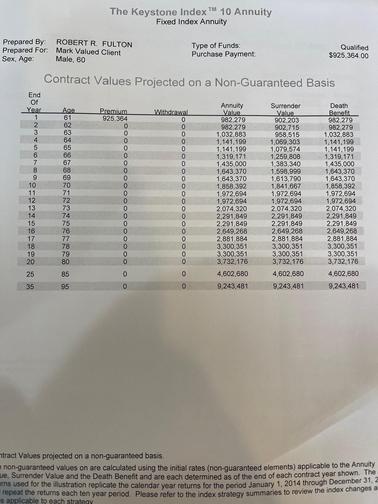
OPTION ONE Concept Continued: To the right is a summary page showing the results of rolling over the $925,364.00 of 401(k) into a FIA. This is page 5 of 10 of the full illustration that you can open below.
Option one, would be the design option that has them living on their pensions and social security income, while just letting their IRA's grow.
Do not forget she has her own IRA to just grow to which is in addition to this one.
Again, to the right is a pic of the summary showing the potential growth of the account values if history repeated itself, which shows him accumulating enough money to purchase the nursing home he may be living in for $9,243,481.00 cash at age 95 Lol! That was not his goal or objective. Of course, at age 95 he may not remember he has an IRA, lol.
This summary is page 5 of 10 of the full proposal which you can see below by double clicking the PDF below to the right which is "just" for Mark's IRA growing.
|
 |
| Ha! By age 95 he could buy the nursing home he may be in! LOL |
|
|
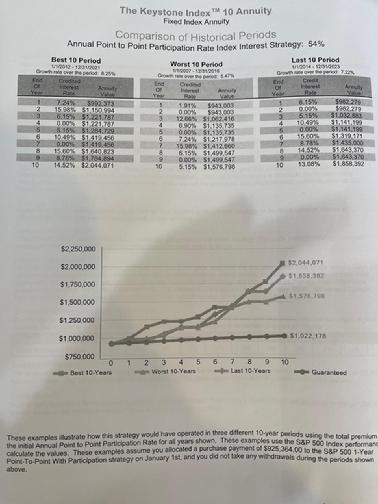
To the right is a photo summary of Page 7 of 10 of the full proposal that you can open below.
The full proposal is based on the most recent period but there is also a "Best Period" as seen on the left side of the summary.
|
 |
| As seen on Page 7 of 10 of the full proposal below |
|
|
Above to the right is a pic of a summary which is much more realistic, because the summary of Historical Periods is only for a ten-year period. That matches closely the time period which they could delay receiving his social security benefits. This shows the best period accumulating $1,000,000.00 dollars more than he started out with. Again, you cannot count on that repeating itself, and I am not just saying it because I do not think it will. (I need to always add those words to cover my compliance needs.) Ironically, it is very possible it will do better. It makes if profits off of volatility in the stock market and I think that will be worse than ever in the future. So, worse volatility means better profits with this program. Then you can see the worse 10-year period which shows potential growth of over a half a million on Marks money. Then also as you can see it shows the last period of time is in between.
|
OPTION ONE Concept Reviewed:
A quick review OPTION ONE was the design that has them living on their pensions and social security income maintaining their chosen lifestyle, while just letting their IRA's grow.
Click the PDF on the right to open the full original and complete proposal "just" for the 925K IRA growing.
| 
Illustration #1 Mark's Full 925K IRA no income draws just growing |
The key page is 6 of 10, you can view the guaranteed values on the left and view the "non-guaranteed values" which is the far-right column. This is very interesting as it shows the potential "if" markets hypothetically repeated themselves, he would have had his $925,364.00 grow by $933,028.00 during this ten-year period while they would be living on their social security income benefits and their three pensions. Then as seen on page 7 of 10 on the far left "best period" shows it with a value of $2,044,041.00 which is over $1,118,707.00 more than his 925K deposited, and that is by the time social security would offer you the max benefit, at age 70ish collectively. I will review below the math to show, at this time to what those benefits would be if they delay them 8-10 years. This math has been done by me (a human not AI). This suggest that the future economic value of their combined social security resources in ten years (or when they both are age 70) is a very impressive $1,401,539.00. This is based on out of date social security statement from 2019. But to get that they both must live the full ten-year period. We need to compare that to the economic value of their current combined social security resources which is $883,138.56. The review below will go deeper into the weeds, but this indicated a gain in net worth so to speak of $518,400.50 for waiting for benefits from social security until age 70. Yes, while that is impressive and valuable it is not as good as the potential gain in the 925k IRA just letting it grow which is $414,628 more than that in "most recent period" (not the best period) and MORE THAN TWICE what the gain would be in the best period, which again, is this next ten years while exploiting the social security resources, to live on.
But there are two issues to comment on: First this "numbers presentation" is aggressive because it is a re-projection and the other is conservative because it does not include the potential for cost-of-living increases.
Then the magic is they can start drawing income against the two million dollars from the IRA(s) and still continue to receive his and her lower social security benefits of $4,415.00 (that they have been receiving all along) adjusted for COLA increases. So, at that future point they would have the advantage of receiving both. So, life should be looking better to deal with inflation and improve lifestyle than ever before.
|
|
So, you just viewed an educational illustration showing the power of 925k going into a (single account with every egg in one basket) FIA (Fixed Indexed Annuity) and allowed to accumulate without any withdrawals. While seeing (viewing) those numbers in a single account can help make my building block education easier to help you learn things, but it is something in real life I would resist under my watch, that is without the written consent of my client.
So, even though annuities are “very safe,” common-sense investment diversification suggests that we should divide (or place) a portfolio or one’s nest egg in more than one place.
|
Let us review what “very safe” means to me. The positive aspects of the Fixed Indexed Annuity contract is that they are designed not to go up and down like a mutual fund. Then the Capital Risk is borne by the insurance company who underwrote the contract not my client, the annuitant. Then that insurance company insures and backs that account with its full faith, promises and that is extended to being backed by the General asset of that insurance company (so we need to look at AM Best Ratings) not the Annuitant. Then also with Fixed Annuities, the Annuitant is further protected with the State of Washington’s Association fund for up to $500,000.00 per individual (not per annuity), for their deposits in Fixed Annuities including the hybrid spinoff cousin the “Fixed Indexed Annuity” shown here. (But agents need to learn that this protection should not open the door to offer weak companies with strong quotes to make sales easier.) You can do a Google search on your own, of the “Washington Life & Disability Insurance Guaranty Association,” to get the information directly as published by them and not from me officially, for my compliance needs.
I believe all the states have these "association" funds, and Washington has one of the best. I am licensed in WA, OR and AZ and each of those at least has this type of fund for protection. This is "publicly" accessible information that anyone can get. I have printed this information for myself, going back to 1992. which shows it has been around for a while. I would be happy to share that with you.
So, the takeaway here is I feel this 925k needs to be split between at least two institutions. I also like diversification between plan design scenarios such as accumulation and income accounts. I also like diversification with tax scenarios, i.e. qualified, non-qualified, taxable, tax differed, and tax free, when I can get it, too. But that does not apply with an IRA, they are all qualified.
|
The first would be to put your IRA asset into a SPIA to have level consistent income. The illustration for that is just to the left above. The other option other option is to put it into the same type of FIA (Fixed Indexed Annuity) I showed you for OPTION ONE above BUT pull withdrawals of $4,415.00 every month. This is seen on the illustration to the far right above. The key page is 6 of 10, view the "non-guaranteed values" which is the far-right column. This is very interesting as it shows the potential if markets hypothetically repeated themselves, you would still have your $925,364.00 even after receiving $4,415.00 per month which is how much both of your social security checks would be! But this is at the moment just hypothetical information since we are not getting that from social security but from our IRAs.
The column to the left of that which shows the withdrawal of $52,980.00 per year, which is $4,415.00 a month.
|
 |
| Let's talk about what to expect next |
|
| Since I am writing with Italicized font you know I am talking to the audience slightly outside the core case narrative. I have become bored with the computer/coffee/pen photo which I have been using so I am switching to some pics of me. As I explained in the beginning, this is a “real” case study. It is literally a live, active and actual situation. I just let my clients know that I have completed the first half, and I wanted to have them visit the site. They will need to hit the refresh button on the computer’s browser each time one goes on the site to be able to see the last update. I asked them to review my fact-finding data for accuracy and make any correction needed to my perception of their goals and objectives. In addition, I asked them to send me some simply one paragraph emails with questions that I could then build that information into my narrative project to make it as germane for them as possible. I am going to outline below the specific agenda or schedule of items, calculations, illustrations, diagrams and mathematical annualization I plan to post in the next chapter “so to speak” or sections.
I will be diving deeper into the weeds to show the pros and cons of either of the two private sources, to provide your income. They are the SPIA which I will compare and contrast to the option of using a FIA (since they were my last two illustrations show just above) if you subscribe to OPTION TWO. As a reminder this is the option that protects your social security resource asset by not using it for the next ten years.
|
Then I will likely “try” to just jump to comparing those private sources of income you could elect, rather than to accepting earlier access to your social security benefits. I will illustrate to (us all), which scenario develops the best or highest net worth for your future reserves in later years when you reach your seventies. After that, I will do a complete review for you of what I feel are the advantages and disadvantages of drawing social security as soon as possible or waiting to age 70, financially and non-financially. Then, after I study all this for myself, after your input, I will provide my opinion which I would do if I was you, if not self-evident automatically. In the meantime, view the one-minute video to the right to see my face in a decision-making moment.
| 
Sometimes we must choose a direction |
Bullet summary of SPIA
SPIA: Means Single Premium Immediate Annuity
They are straightforward and easy to understand.
I think of it as the opposite of life insurance which protects clients from “dying too soon”, as SPIA’s protect one against “living too long.” The strongest benefit is it provides income you can never outlive. The joint ones, continues that income to your surviving spouse uninterrupted when you die. You never have to worry about financial management decisions when you get older regarding this income subject. It is the best source of level income there is. I feel there is a risk of buying too much SPIA, which you will understand more when you read more below. But in a nutshell because of the liquidity issue, so you also must have cash reserves in addition to a SPIA. The FIA (Fixed Index Annuity) is designed for accumulating and I feel it is like a storage tank for your funds and provide the balance for the liquidity you need. Holding them (your funds) while you get older, from an actuarial point of view, which has benefits, should you later want to buy an SPIA. So, in the future in this case the theme is eight years of waiting (age 62 to age 70 for her and 10 years for him.) The payout could be a few hundred of dollars a month higher for waiting. So, in the meantime you can take systematic set dollar amount (to meet your current needs) withdrawals out, of the FIA for income, reduce that income, suspend that income, stop it, increase that income anytime. I think of it being like as a water faucet that you control the flow. There is no flexibility like that when using the SPIA for income, nothing can change the income which is also great in other ways.
Ok, as you have noticed, I am jumping into first talking about pros and cons of attributes of SPIA’s and FIA’s then I can better build from there, overlying the comparison of social security income to them as well as the timing of initiating social security income to provide supplemental income in addition to your pensions.
Section 10B
First, I want to remind you about something I did on that the last excel spreadsheet, when I provided my 2nd version of initial ideas in preparation for our last email and phone meeting, a few months ago. Based on instinct, I split the allocation of the $925,364.00 IRA money equally with 462.6K going into a SPIA and 462.6K going into a FIA for diversification and for a structured balance. So, keep that in mind as I share this next section of the narrative. That diversification was also to split the asset with two or three different institutions, for reasons I have explained before, and associated with 500k WA state fund etc. I may drift back to that concept, in my final conclusions since it has a lot of merit. We will see as we check out the merits of that and its alternatives, which we are about to explore. But in addition to splitting the mix, it also reduces the chances of making a wrong decision that is irreversible.
What I am thinking about in my head now is how some decisions are irreversible and others at flexible and can be reversed changing one’s path.
I will give you examples of some because I feel you need to understand these so we can factor them into the structure of the plan. This is because of the consequences or ramifications of each.
If you purchase a SPIA (Single Premium Immediate Annuity) it is irreversible on your part, meaning you cannot get back your deposit premium as an “all at once” cash withdrawal as a lump sum. However, on the flip side of that it is also irreversible on the part of the insurance company. They cannot cancel the contract or modify the payout rate; the rate it was built on is locked in for both of your lives. (Ha a cat has 8 lives!). I mean for as long as the survivor of you lives, of course. However, even though it will not be a lump sum, it is guaranteed you will get the money back, dead or alive, based on the features and provisions of the contract (unless you tell me to change that to a shorter certain period). With your young ages, it has an impressive feature with the full 30 years of guaranteed income totaling $1,663,390.00 after putting in $925,364.00 representing a gain of $738,026.00 over what you put in. That is not only impressive, but it is very conservative in nature because it is guaranteed. You will notice on the proposal quote with access by clicking on the PDF above, if one of you lives to age 95 the total guaranteed payments would add up to almost 2M, $1,940,622.60 as displayed on the illustration but it does not stop there. The monthly income will continue until the death of the survivor. In comparison my proposals for the FIA product are all projections, reprojections and based on computer rebuilding and so-called back testing of historic experience and performance in the S&P 500. But there is a floor to the value of the FIA accounts, at least what you put in, but the product is not as conservative as it is not about guarantees on the returns. I refer you to the company’s disclosures for more information.
Delaying the SPIA purchase will potentially work for you, to some extent as your age gets older the mortality factor just like social security benefits cause the payout to go up. But if the interest rates go down between now and then that could work against you.
So that is the case for funding your future with a FIA, now for the next ten years then purchase a SPIA. Current interest rates for SPIAs are possibly the highest now then ever and may start to go down with the cycles of the economy. I do not have a Crytal ball. So, if the rates go down, that may or may not be totally offset by the age factor getting higher. So that could be closer to a wash, and self-curing in about five years, which is not the end of the world.
Section 10 C
However, I see what I call interest rate sensitivity as an opportunity affecting both the SPIA and FIA product. I think we are in a very hot fire sale market for SPIA that we will never see again. I have explained that enough about the SPIAs but not the FIAs. We are in a hot opportunity time to purchase FIAs as well.
Here is my personal generic observation across the board as a professional having sold over a thousand of them over 39 years. The FIA product is designed in a way that the funds collected by the company for a list of FIAs, of or in a specific time periods of contracts being issued are pooled and go into the purchase of a block of bonds, for that time-period. These, for what it is worth, carry the same market value interest rate risk of any bonds, since that’s what we are talking about, bonds. But remember the insurance company underwrites the capital risk not the annuitant. Then at the end of the term we get 100% of value resembling PAR as associated with bond values. Those bonds earn interest (coupon) nominal yield. The interest is paid monthly or every six months and goes to the insurance company and is earmark for funding two things. First the profit margin of the insurance company, which is why they do it in business. Second, the purchase of call options against the S&P 500 that are exercised in the years that the market goes up in value at all and manifest itself in an interest credit to my client’s FIA. In the years the market goes down the options just expire, and no interest credit or loss occurs. The companies do very little to refinance these bonds to new bonds with higher interest rates, or lower rate for that matter. So, the results are very sluggish to have the formulas to change, that would translate to improved interest credit profits. Sometimes I call it wrong, what rates will do in the future. But my feeling currently is very strong that we are in a temporary higher interest rate period, and we are going to see rates go down relatively soon, but not down to 2020 levels. So, because of this sluggishness clients who purchase an FIA now are going to enjoy strategy formulas within their contract that are very profitable into the future. This is like that seen on the 925K FIA “full” proposal I am showing in this case study for at least 8 years of the 10 years of the contract. I am leaving this illustration in for educational purposes even though we will actually spilt the pot into two pieces and one half of that is into a SPIA. This, to me, while maybe not to you and it is your plan the FIA offers a little more aggressive potential opportunity for growth. Plus, as well as the flexibility to control the specific amount of monthly income you actually need to live on, because you can adjust as needed. Plus, as well, the opportunity to take the left-over funds in the contract (see illustration #6 page 4 of 11 Section 13A) in the future, say in ten years or more, can then be use it to purchase a SPIA in the future, possibly enjoying the high payout reflecting an older person. But we do not know where the interest rates will be then and that is a component factor in the payout of that future SPIA.
As I always say everything has a yin and yang. Unfortunately, that sluggishness that is likely to be providing a current wonderful opportunity to new clients, doing new rollovers now. However, it is not as exciting for those who purchased their FIAs in period of lower interest rates, say in August of 2020. Let’s say those accounts for this current period, I feel are overly conservative. As soon as interest rates come back down this subject will not be as embarrassing You may have noticed on the last spreadsheet, I have had a theme, to move her IRA funds at the rate of 10% (of contract value) a year into SPIAs while we are still in this SPIA fire sale period. But I am trying to do that only in years that we are not seeing a profit coming on the anniversary date. I call this while we, “are in the money” like our current year. This is how I am bringing your overall portfolio back into balance.
Section 10 C2
Back to the subject of social security and other issues………...
If you start to receive social security income early, after twelve months it becomes irreversible, in the meantime you could stop the income, payback what you received during the last eleven months and re-suspend the benefits, to let that resource grow under management with the government. On the other hand, if you defer benefits, you can revise or reverse that anytime and start enjoying the income, should that be in your best interest. So deferring benefits add much more flexibility to the planning. But as you can see also choosing to go with Plan OPTION ONE can be reversed for up to a year. This reduces the risk in the decision-making process, a little.
Delaying benefits has always been very attractive to single people with lower incomes and lower assets or resources than you two, and “two” is the operative word, as a general rule. This was because the program was set up or designed only to provide a base pay to the masses when they all got too old to work. This was aimed at or for those who do not have pensions or saved nice 401(k)s etc. The better or higher the base pay is, the better they can cope and get by. Meaning, waiting to draw on the benefits allows the benefits, the specific monthly benefits to go up an impressive 8% a year for the years after FAR, which is a four or more-year period that is very meaningful. Yet, I need to ask why only 9% of all recipients wait that approximate four years after their FRA to draw on them, to get the highest payout? My observations are that even though they still work some, their focus is on overcoming the survival mode, that they find themselves in and often start receiving the benefits right away, because they need to, to pay rent and basic expenses of life.
Therefore, I feel that generally people just above “poor” are better to wait as long as possible to start benefits. Those who are well off financially if they are a good steward of their money (can set goals, make plans and have the discipline to stick to the plan), on a case-by-case basis, may be better off to draw the benefit far earlier.
Well off, means those like you who could get by just fine even if social security never existed, therefore do not need base pay to survive. Far earlier, means or is for those who, are positive, they will stay retired and not need or want to go back to working for wages that are FICA taxed before FRA. This is because of the Offset penalties are huge.
FRA means, Full Retirement age.
Therefore, drawing benefits earlier comes with the costs or risk of making it irreversible to leave retirement in some ways.
I feel there is one issue or reason the opportunity to delay benefits may be less attractive for a married couple than for a single person. When a single person is between 62.1 and 69.9 (about 8 years) delaying benefits still, dies, the benefits remain with the Social Security System and benefit others, but not the person that we are writing about in this paragraph. If they die quickly, they (a single person) will not care or miss the benefits (although their heirs may have needed that money, to help with their survival mode.)
On the other hand, when talking about a married couple, if both the married spouses were eligible for benefits like in the case study. If one dies, the surviving spouse will keep the higher spouse’s benefit the other lower benefit is lost. Well, it is not really lost (but to you guys it could become so) since it goes back into the pot and dividend up with all the other future recipients of social security benefits. This is just one factor to be aware of when annualizing things and that includes if you actually decide to delay benefits during that time you will be spending down your IRAs like seen illustration #6. Keeping this money is one of the ways the 8% increase is funded. But for my specific client discussed in this paragraph that could be a loss of thousands of dollars. In this case perhaps, something like the potential of $1900 X 96 months plus COLA increases less income taxes that would have been payable out of that income. So, we are talking about a loss of more than $150,000.00 to our specific household. The refers to the household of the surviving spouse. If both spouses died this could be about $300,000.00 that your heirs would not receive. To me the take-a-way is, while delaying benefits get you a nice increase, it is not as bulletproof as a “for sure thing” as is may appear. It kind of reminds me that my reprojections of all the wonderful grow on my FIA proposal is also not a “for sure thing” but I see it as one of the best of all the alternative ways of skinning a cat. I have done some comparisons if they become needed, using the guaranteed values to prove my points.
Another factor in the formula so to speak of why Social Security benefits will increase if you delay receiving them is just like a private SPIA contract, that we talked about above if you delay purchasing it. That is the mortality factor, the older you are the shorter period the payout period will be, so it is pushing the benefit higher.
As I read through my work, I see a valid case for many financial as well as some non-financial reasons for a couple like in this case study to draw social security benefits early and use diversification of their overall positions and to put all of the 925K to work, splitting between a FIA and SPIA. I will soon run the number for you on that.
But what does the actual math look like when we cut through the chase and calculate the economic value of the larger social security benefit provided by the government if they delay them. Then compare that to the cash value build up the FIA proposal indicates on proposal for the 925K IRA rollovers.
Section 10 E
I have used what I call the capitalization method to establish value like an appraiser would cross reference to get to the value of a commercial real estate building.
Based on the two Social Security projection statements, shared with me, from them the client, which was provided from the social security administration dated 11/25/2024, the total income from social secure will be $8,272.00, and that is for both when each are 70 years old. Here is the math…………..
$4,737.00 per month at age 70 for him.
$3,535.00 per month at age 70 for her (a little after that age of course).
$8,272.00 per month is total. But they are not becoming 70 at the exact same time.
So now this is the way I am going to establish value for the comparison.
$8,272.00X 12 = $99,264.00 divided by 5.99% (.0599) = $1,657,162.00
Based on the same soc sec statements they will but receiving $4,605.00 total month if they start to receive these benefits as soon as eligible.
The economic Value =
$4,605.00 X 12 = $55,260.00 dividend by 5.99% (.0599) = $922,538.00
Comparison: $1,657,162.00 "Value of future benefits if you wait to ages 70ish."
- 922,538.00 "Value of benefits if you start when eligible"
= 734,624.00 profit or gain in value for waiting to start benefits at age 70.
Now compare this to the increase in the cash value build up over the 925K in the FIA IRA until each or the ten-year period in each of the ten-year periods (worst, best or most recent) you are likely to do better.
The most recent ten-year period as seen on illustration #1 page 5 of 10 in Section 7 which you can view and see it could provide or projects a total account value of $1,841,667.00 Less what you put in - $925,364.00 = Equals a gain over the 925k of = $916,303.00
So, you could have a little less than the historical performance and still do as well.
I think I have STARTED to make a case to show how, if you take social security earlier and live on them, you can grow this money (your IRA money) on your own, since you do not need it to supplement your income (since you would be using soc sec income for that like our Plan OPTION ONE) and beat the growth in benefits that the delay of social security benefits would provide you, and you can accomplish this without traditional investment downside risk, or legislative risk causing a change in benefit, and not give away some of these benefits if one of you dies during the next 8-10 years. Is my case good? YES, but is it perfect NO; my operative work was STARTED. I have started more to come! It is necessary that I do get it perfect.
|
So, we have learned by my math if we leave our social security resource under management with the government, they (the resource) will increase in value as a conversion to an asset by $734,624.00 based on my math calculation methodology which is using the capitalization rate of a SPIA payout at your ages jointly.
Now let us hypothetically compare that, to what those resources would be valued at if you start to draw them now, BUTTTTT keep them under management with you and I privately in a NQ flexible premium tax deferred annuity that you can control and not the social security administration.
I call this "Re-direction of benefits" whereby you receive them but do not spend them just save them.
This also may provide you some other benefits such as:
Your family is the beneficiary of the account and they are vested from the start date to the date of death, anything accumulated goes to them.
You get all the COLA adjustment increases and you can save those as well. I think it is very transparent and clear that you can have and receive these and hold them, they are yours for sure. If you leave these recourses with the government, it is not as transparent to me at least, as to what extent you may be helping to fund the 8% growth that they promise everyone. But when I study and compare all your social security statements it looks like you would get those equivalent to cola increase either way.
|
I will now get closer to proving that the redirection of the social security income going into a private account that you control rather than leaving it with the government may result in some respectable values and put you in a better liquid position to meet goals, in your future. First if you die your family are beneficiaries of the account, that I am about to show you, and it builds up slightly more than that $734,624.00 gain you see in the math above that the government will give you but only using the most recent historic performance and counts on that history repeating itself. That number is referring to the grow in benefits if you delay receipt of them until 70ish.
You will see by clicking the PDF to the right, opening the full proposal, on page 7 of 16 the guaranteed contract value would be $558,000.
Then a page or two later you will see the non-guaranteed values projection builds to $754,297.00 using the past history, and that of the most recent ten years.
The point here is so far is after I received the new update social security numbers I cannot make as good of a case to exploit the social security resources as soon as eligible.
|
Illustration #11 Saving Soc Sec income $4,600 per month away from gov |
| Section 12 Starting to pull things together and drawing some conclusions |
To Client: Hopefully, after reading my work so far, I am assuming, (but would like it confirmed) that you are feeling at this point, (compared to the mouse photo in the beginning), 100% confident you, can join your wife in retirement, at this time in your life, if that’s what you want. You have seen that regardless of which Plan OPTION ONE (using social security benefits to live on) or Plan OPTION TWO (delaying soc sec benefits), both roads and paths provide the mechanism I said you needed to protect yourselves from any conditions thrown at us because of inflation.
You have seen regardless of the methods you use to either accumulate your IRAs or use them to produce income you will enjoy nothing but financial abundance in your life beyond that in your future. This is while maintaining your current lifestyle and standard of living. I see you in the future being able to elect to self-insure the risk of living too long association with long term care expenses for the elderly, whereby avoiding needing to pay real high premiums like I see a lot of people doing for peace of mind to cope with that risk. As one grows older, we worry more about that risk.
To me at this time in your lives, it looks like this projected level of abundance in your futures is yours without taking any needless financial risk. This includes but not limited to part time employment for extra income; or the traditional stock market capital risk or in real estate investment ownership for profits to convert to income to live on.
|
| Confidence Level Indicator Below |
 |
| Before |
|
| The photo to the left depicts the confidence level in the beginning of the case study.
The photo to the right depicts the confidence level now at the halfway point in our planning with your ability to retire at age 60.
|
 |
| After |
|
|
| Section 13 A: Confirmations and redirection from Sunday's two-hour phone meeting. |
To keep things simple and less confusing I will first do some confirmation about what we have agreed on so far then review that to provide some clarification and exploration.
We have both subscribed to splitting the 925K rollover funds into two types of pots or buckets.
Immediately below is part of the narrative are two specific product illustrations, displayed or shown stock off the shelf without any twigging, before showing some variants to meet your specific needs, like income. It is very important to understand these variants as they allow you to make modifications to meet your needs better. If you do not make decisions on these types of subjects, then someone else will do it for you and in the long run may not be as suitable for you in the long run. So that is what the next section is about.
|
The first is $462,682.00 (or the exact amount with the next version of your 401(k) statement, please send me an update), into a SPIA (Single Premium Immediate Annuity) with Penn Mutual to provide a Joint level monthly income of $2,309.02 that neither of you can outlive. I have provided an illustration of this specifically to the right.
This $2,309.02 is before income taxes. The net is $1,801.03 per month.
|
Illustration #5 SPIA producing $2,309 per month income |
The second half or the other $462,682.00 into a FIA (Fixed Indexed Annuity) with RSLI to serve as an accumulation bucket seeking growth while at the same time, taking monthly draws out of $2,200.00 starting in 29 days, after delivery of your contracts, as you enter retirement, with a target date for that income to start on February 1st, 2024. This income on this illustration continues until "his" age 70. This is to supplement your monthly income to meet your expense in retirement at least for the first two years. (((“At least” means until social security income commences; and that is the subject I am going to talk with you about))). This $2,200.00 withdrawals for income are before taxes and $1,711.32 after taxes.
|
Illustration #6 FIA $2200.00 monthly income withdrawn 10 yrs |
The purpose of this split is for two types of diversification. The first is for that of Capital Risk seeking preservation of your money (two contracts – two institutions – easy) and the second is for the plan design, with protects us from decision making mistakes regarding future interest rates, and program availability in periods of economic downturns, and changes in government regulations.
|
This shows income stopping from FIA and you turning to soc sec income. Which is an option, and the cool thing is you do not need to make any decision about that for two years. But you will learn soon I am more neutral on that subject than I was planning, and I will soon share the new math after I receive the updated soc sec statements.
Some other considerations are:
We have his and her IRA's. After two years the IRA account balance will be more equalized after he spends down somewhat for 24 months to the tune of $26,400.00 per year. I put 12% ($55,523.00) in the Fixed interest account (currently 4.6%) to help protect his account balance, in case the S&P 500 does not go up for two years he is not going to take a hit. However, my software does not allow me to illustrate withdrawing it solely from that Fixed account.
The point I started to say is in 25 months if they (you) do not elect to start drawing social security benefits we could talk about closer to an equal or equitable income withdrawal of profits also from her IRA to stop the blending on this one. It has been my intention to start moving 10% of her IRA into SPIA for the production of income. So that is an option and a nature one. This operative word there was "equitable" and that has to do with his will have better earnings.
|
Illustration #7 FIA $2200.00 monthly Income withdrawn 2 yrs |
I feel it is only natural to cross reference this one.
This is illustration which is akin to the illustration #1 (with 925K-Just growing) initially provided in Section 7, is the exact same FIA product but the initial rollover funding reduced to $462,682.00 (Split as we decided on) again as I call it "stock off the shelf" without any modifications. The illustration shows you putting in the 462k and just letting it grow.
This is provided here so you can compare it to illustration #6 with $2,200.00 coming out until age 70, which is your final year you could delay soc sec benefits. Then also compare it to the illustration #7 which shows you electing to stop the $2,200.00 per month coming out and fund your budget shortfall with drawing soc sec income at age 62 which as you are about to learn.
|
Illustration #8 FIA 462K just growing into the future |
Illustration of SPIA 30 year certain
In Section 13A above you were provide illustration #5 which is one of the two core "split" foundations of the plan, again stock off the shelf without any modifications except one key one it, which was we agreed to cut the amount going into it in half and that of $462,682.00. Other than that, it is as I have been showing you, a “Joint and Survivor Life with a 30-year Certain Period Guarantee. The illustration shows you receiving $2,309.02 for as long as one of you is living, based as typed: “Annuity payments are guaranteed for the lives of two annuitants or for a guaranteed period of 30 years, whichever is longer. We need to talk about how you control the guaranteed period. I am showing 30 years a great feature available because of your young ages, but there are options from Zero years to 30 years. Just below are two additional options rather than that of 30 years.
|
To the right I am showing two variations of this (illustration #5) modifying the guaranteed periods, the one to the immediate right is for a 20-year period and the one to the far right is for a 10 year period.
So, you can see there is a reduction in monthly income as you lengthen the guaranteed period which is the cost of the longer guaranteed period.
|
Illustration #9 demo of 20 year certain |
Illustration #10 Demo of Ten Year Certain |
So, this has to do with that conversion last Sunday about leaving a heritance for kids.
Just to be clear this is only an issue if you BOTH die way earlier than expected. If even one of you leaves for a long time you keep receiving money and win against the insurance company and you can see that as an example on all the illustrations if you live to age 95 you will receive over double what you put in and almost a million dollars.
The purpose of that was to help you understand the features of the contract (you select) and how it to some extent controls family legacy balanced with higher income.
Please confirm for me you want the 30-year guaranteed period.
|
 |
| This morning, I am grateful for two things |
|
| As I sat down at my computer early this morning, I thought how grateful I am for two things.
First, that I have you as a client and you have invited me to help you with this case study project. Thank you.
Second, that I do not have to write a long wind supporting narrative for the Social Security administration on how they are going to be able to get the funding from all the American tax payors to make good on all these retirement income payments. I am very worried about their ability to deliver on all these Social Security Statement letters. Thanks for sending me your updated ones. Wow! Truly amazing and likely, no for sure the best I can ever remember seeing, nice. When I read them, within a moment it triggered emotions, that were non-financial in nature. I will share soon share the results of revisiting my math to see if those thoughts, at that initial moment were justified.
|
I received your updated letters from the Social Security Administration dated 11-25-2024. Thanks.
I did not expect that I would see a disproportionally higher net gain in benefits for delaying the use of the social security resources like I do NOW, after I reworked the math in Section 10 E from your updated letters.
So, I can keep the flow going here of your reading below and above the dotted line is a cut and paste of the rework math.
............................................
|
I have used what I call the capitalization method to establish value like an appraiser would cross reference to get to the value of a commercial real estate building.
Based on the two Social Security projection statements, shared with me, from them the client, which was provided from the social security administration dated 11/25/2024, the total income from social secure will be $8,272.00, and that is for both when each are 70 years old. Here is the math…………..
$4,737.00 per month at age 70 for him.
$3,535.00 per month at age 70 for her (a little after that age of course).
$8,272.00 per month is total. But they are not becoming 70 at the exact same time.
So now this is the math as I establish value for the comparison.
$8,272.00X 12 = $99,264.00 divided by 5.99% (.0599) = $1,657,162.00
Based on the same soc sec statements they will but receiving $4,605.00 total month if they start to receive these benefits as soon as eligible.
The economic Value =
$4,605.00 X 12 = $55,260.00 dividend by 5.99% (.0599) = $922,538.00
Comparison: $1,657,162.00 "Value of future benefits if you wait to 70ish."
- 922,538.00 "Value of benefits if you start when eligible"
= 734,624.00 profit or gain in value 4 waiting 2 start benefits at 70.
Now compare this to the increase in the cash value build up over the 925K in the FIA IRA in the most recent ten year period as seen on illustration #1 page 5 of 10 in Section 7 which you can view and see it could provide or projects a total account value of $1,841,667.00 less what you put in - $925,364.00 = gain over the 925k of = $916,303.00
...........................................................
So, you could have a little less than the historical performance and still do as well.
I think I have STARTED to make a case to show how, if you take social security earlier and live on that, you can grow this money (your IRA money) on your own, since you do not need it to supplement your income (since you would be using soc sec income for that like our Plan OPTION ONE) and beat the growth in benefits that the delay of social security benefits would provide you, and you can accomplish this without traditional investment downside risk, or legislative risk causing a possible change in soc sec benefits. Also, and not give away some of these benefits if one of you dies during the next 8-10 years. Is my case good? YES, but is it perfect NO; my operative work was "STARTED". I have started more to come! It is necessary that I do get it perfect.
|
|
|
The numbers above reflect a revision to my previously work which was done (calculated) based on the social security statement letters you gave me published 12-21-2019. That prior work's math indicated a net gain for the delay of $517,062.00.
After I received the updated social security letters published on 11-25-2024 the same formula now indicates a net gain for the delay of $734,624.00
|
The point here is the new projections from the social security administration indicate that we now would have an additional gain or profit of $217,562.00 in value for waiting to start benefits until age 70.
Woo! To see if this is new information, is a game or theme changer either for financial or non-financial reasons let’s do the 2nd half of our review as we did before without any modifications. But the good news is the first half of the review you can see the numbers on the surface look pretty favorable.
First two things. When I first introduced you to my formula to establish value using you 2019 soc sec statements, which was remis of me. I was able to beat the growth for delaying benefits by only using the “worst historic ten-year period”, which made me be very conservative. But now I have needed to be somewhat more aggressive making the comparison with the ‘most recent last/latest historic ten-year period” when the market performed better. FYI: Well at least I did not have to resort to using the “best historic ten-year period.” That would make me feel like I had to use sales tactics, which would be out of my comfort zone and in the unethical category. Now I am ok with using sales tactics to get you to retire earlier but need to use a fair review process for the numbers associated with each path of your option for your decision making. These historical ten-year periods are displayed on illustration number #1 page 7 of 10 found at the top of Section 7.
Second, in the first have of the review above I compared the very strong growth you may be able to get by delaying benefits to you putting all the 925K in the best FIA I can find on the market. Next, FIAs are growth oriented, however in real life we are splitting the 925K rollover funds 50/50 with a SPIA which in income oriented. So, the review is interesting and looks very positive but is far from “perfect” since it is not all conclusive. So now I will expand this review to encompass that as well in Section 13 F below.
|
In this section I will share my thoughts of using a SPIA which is designed to produce income but saving all that income for growth and compare the end result at the ten-year mark to “the promise” of future economic gain by delaying social security benefits.
Now this is a concept that we talked about (never went deep into it) so you may find it somewhat familiar with the concept.
In your plan that we have agreed on so far 50% of your rollover is going into a SPIA to produce monthly income (but not to be saved), that will be used to live on (in addition to three pension and a monthly withdraw from a FIA), for at least the next two years. That’s two years no matter what, while you wait for social security income eligibility.
|
So, let’s look at comparing the economic value of the delay benefits which we calculated to be potentially $734,624.00 to the future ten-year mark results of the cash value of a NQ Flexible Tax Differed FIA which received all it’s premiums or deposits from the monthly payout of a 925k SPIA. You previously view this SPIA illustration #2 earlier in Section 8B and view how it cracks out $4,620.53 per month which we are now going to save in Flexible (flexible means it allows monthly premium deposits) FIA and not spend. However, to make your viewing easier and not risk confusion I have put that illustration #2 in the box to the right.
The purpose of this part of the review to do this hypothetical drill is for my education to get the information I need to know to share with you the components of each part of the decision-making process you need to execute.
|
Illustration #2 of SPIA |
Because ANICO’s software is the most accommodating it allows me to do creative illustrations, so I am using their product illustration #11 for educational purposes, found in box to the right. When you open it you will see how it is collecting the $4,620.53 per month payout from the SPIA (illustration #2) each and every month.
|
Repeat Illustration #11 saving SPIA Payout monthly |
When you open illustration #11 above on the right and go to the “Non-Guaranteed Page” (9 of 16) you will see the re-projected annuity account value has grown to $754, 297.00 in the most recent historic ten-year period (ending 12/31/2023).
Remember the projected value of the promised delayed soc sec benefits is $734,624.00. But to maintain perfection in presentation please only use that information (of non-guaranteed future values) as a cross reference in your goal setting purposes. So, I do not need to say, “if history repeats itself”.
So, please change your viewing to page 7 or 16 and study the “Guaranteed Contract Assumptions” which shows after 10 years accumulating value of $558,341.00.
So when we use my guaranteed value of $558,341.00 to the social Security projected value of $734,624.00, it would seem by someone not understanding the full picture, that so far in this second half of our review, (level one so to speak) that we are running behind by $176,283.00 ($734,624.00 less $558,341.00 = $176,283.00). But that is not the case in the bigger picture as I will bring to your attention in Section 10J below.
|
Remember this $558,341.00 of guaranteed funds is not the SPIA having grown it is just the saving and depositing as premiums the SPIA income payout each and every month along with the guaranteed compound interest (with no connection or dependence of the gains in the S&P 500 at all), on those deposits over a ten-year period of time.
In all of this you do not want to forget that at the end of the ten year period you still have the SPIA contract. I will tentatively for illustrative purposes say that SPIA to be worth $925,000.00 so now we had that to the $558,341.00.
$925,000.00
+ 558,000.00
$1,483,000.00
Hmmm, so far, I feel comfortable that I have made a supporting justification for the diversification with the 50/50 split between SPIA and FIA but not a real strong case for the merit for starting social security benefits early. It may look like there are not a lot of mistakes involved either way, but I was hoping to do better than that, and I will tune that statement up in my conclusion in Section .
This caused me to go back and revisit Section 10F and rework those numbers which I revised updated the math and illustration showing you collecting the social security income and then saving it on your own rather than leaving it with the government. Frankly, for some reason I feel my mission here is to continue to support earlier access works better for you than delaying the benefit. But when you sent me the updated statement the differential between the two, from the stale ones to the 2024 after the math was done indicated a growth in the gain for waiting to be over $200,000.00 compared to the gain from the prior statement. I have not been able to overcome this if my goal is to make as case to find it in your best interest to do Plan OPTION ONE which is to use soc sec resource as soon as eligible. If you go back and re-visit Section 10F where that cross-reference shares with you, more information to help understand this.
|
| If you have been having trouble getting your head around weighing the pros and cons of which is best to access social security resource as soon as eligible or wait about 8-10 years, joint the club! Me too!
Remember I said everything has a Yin and Yang to it. Usually things are easier to see, clearer and more self-evident. To help us resolve this I will put me advisor hat on and make a recommendation with two choices and see how they sound and feel to you. See Section 14A below for that.
|
| Section 14A Professional Recommendations by Robert R. Fulton CLU ChFC ? ? |
Here it goes..............................
IF .......... It's About Income ............After tax net disposable and spendable income, then you will like the display results below to help you compare the possible outcomes and see the big picture. You will likely gravitate forwards Plan OPTION TWO. But here is a comparison of where you will be in about 8-10 (the discrepancy in age issue again) years. The column on the left is your NET spendable income if you do Plan OPTION ONE which spends your social security income as soon as you are eligible and to the right where you will be for NET after taxes income in about ten years using Plan OPTION TWO resulting from delaying those social security benefits.
* Not reflecting any COLA income increases. Plan OPTION ONE Plan OPTION TWO
Net combined soc sec income: $3,744.00 $6,452.00
Net pension & small SPIA income: 3,911.00 3,911.00
Subtotal of net spendable income: $7,655.00 $10,363.00
Add back Net 2025 SPIA inc from initial 462K + 1,801.03 + 1,801.03
Subtotal of second level of net spendable income $9,456.00 $12,164.00
Add in TBD estimate new SPIA income from
differential diagnosis and projections of residual + $2,708.00 + 0 ......
liquid from his and her IRA's which have $12,164.00 = Total income = $12,164.00 been either growing while using Plan OPTION
ONE or eroding and spending down while
using Plan OPTION TWO.
* This is not currently adding in additional income that could be generated from residual IRA's which we are just keeping that for wealth. That residual wealth would be between $500,000.00 and $1,000,000.00 pending on market results but is not at risk for capital loss like it would be in traditional investments.
To be clear the $2,708.00 after tax income above in left column is from the additional money (and the growth on that capital) that would stay "whole" (untouched undrained) in your IRAs by not spending down the IRAs as you would need to using Plan OPTION TWO.
* TBD means TO BE DETERMINED
|
If It’s About Time ………… and emotions and about peace of mind, then you will likely gravitate towards Plan OPTION ONE. But is also about meeting your specific needs and not someone else’s.
Check out the 40 second video movie to the right.
|
It's About Time ! |
Time considerations: It is long time to wait ten years (becoming around age 70 & almost 72) to forgo receiving social security income to subsidize your budget for the possible gain of something you do not need at that age, based on our financial plan and may not live to see.
The opportunity cost of that to “me” would be the loss of peace of mind you will have watching your IRA resources dwindle by $311,000.00 rather than grow by $311,000.00. That is $622,000.00 spend or differential. To me that would me, if I was you, which I am not, would be (again to me) a loss of $622,000.00. On the math chart above in Section 14A, I was able to add in $2,708.00 per month of income generated form this asset which would remain YOUR’s implementing Plan OPTION ONE. “
Notice that that income is not on the right column because that is the income list in ten years from using Plan OPTION TWO which spends down IRA resources and negated all future growth over this ten-year period, thus no $2,708.00 net after taxes is generated at all.
Common sense math and time considerations: Look at the cookie jar (involving no interest earnings) breakeven math.
As seen on the chart in Section 14A the net cost to forgo or said differently the $3,744.00 a month X (times) 12 months= $44,928.00 X (times) 10 years = $449,280.00 (not counting COLA increases just even money) is a lot!!!!
If you use Plan OPTION TWO you would possibly get that additional extra $2,708.00 from Social Security which is the positive side (Yin and Yang’s, never go away) but how long would it that to break even?
Here is the math…………………….
$449,280.00 ./. (Divided by) $2,708.00 = 165.9 months ./. (divided by) 12 = 14.08 years.
How old will you be then? = Hopefully still young enough that you will remember that you have a financial plan in place.
I will do the math……………… 70 and 72 plus 14 more years = just over 85!!!!!!!!!!
Defining “Do not need at that age: I am referring to not needing that extra income for delaying benefits as one might think.
Your plan’s budget requirements to currently meet all your living expenses as seen in this case study required net spendable income of $7,423.35 a month. It (the plan) also mandated the need to comply with a provision for the plan to incorporate a mechanism to increase income to cope with inflation, which we have done a good job of factoring in for you. This can be seen on the chart above in Section 14A showing you having net spendable income of $9,456.00 per month in ten years using Plan OPTION ONE (before we added the $2,708.00 per month of net after tax monthly income from our salvages IRA funds if you elect to be in Plan OPTION ONE. This is $2,032.68 more in additional net spendable income in ten years to deal with the terrors of inflation.
Math looks like this: $9,456.00 – (less) $7,423.35 = $2,032.68 more than you need now.
Goal Setting at age 85 anyone?
But what would be the purpose of that extra income? Meaning if you used Plan OPTION TWO what would be the purpose of that extra $2,708.00 income. The question joke (since it is a wash) and a mote point because on plan OPTION TWO you would not have the $2,708.00 of income from the flusher IRA as you would have had using or being in Plan OPTION ONE all along.
While the question I knew was rhetorical when I typed it, it had a purpose to me. Again, the question, “what would be the purpose of the extra income? Oh, I know!
We could use the $2,708.00 to save up the loss of $622,000.00 to your nest egg for not being in Plan OPTION ONE. I cannot wait to do the math! LOL.
But first understand two things to be fair. The $2,708.00 is net after tax income and the $622,000.00 is not truly worth $622,000.00 because it is in an IRA pretax still so we must convert it. If we converted, it hypothetically it over time to keep tax bracts lower the math would look like this:
$622,000.00 X (times) .78% = $485,160.00
So how old would we be if you attempted to save that back into our nest egg resource?
Math = $485,160.00 ./. (divided by) $2,708.00 = 179 months ./. (divided by) 12 = 15 years.
Remember this was hypothetical goal setting starting at age 85, so when we add in the 15 more years you are at age 100! But you would be able to earn some interest on the savings which I did not factor in so you should be able to actually be fully recuperated in mid 90’s.
|
| Section 14B Final Conclusion |
I am excited to have assisted you in assembling a financial plan which has the ability based on your choice, to basically either preserve all your social secure resources for the future to know you have unneeded higher temporary income (starting at age 70 & 71.5 to death) or preserve all your IRAs resource to build permanent wealth (providing a family legacy and long term care funding if needed) for the future which later could be converted to almost any amount of income you could dream needing or want.
I have beat to death the pros and cons of the delay social security benefits or not to the point of risking my report being so freaking long that you would not read enough to understand the value of what I am sharing.
The key thing is my recommendation for the Plan for what you should do exactly with the funds is identical regardless which option you select two years from now, talking about being on board with Plan OPTION “ONE” or “TWO.” So that decision comes with the luxury of the final decision not needing to be made for about 24 months, after retirement. But I would like to know which you currently would choose, now. I am interested if that was confirmed by want, I type below or back in our case study, earlier. I would go with Plan OPTION ONE.
The other part, for my recommendation, which as you know is the approximate 925K 401(K) is to be divided into a FIA with RSLI and a SPIA with Penn Mutual.
Please send me an updated, formal and most recent 401(K) statement, all pages, for future file action movement and so I can compare the exact numbers to those from my verbal fact-finding for damage control (those out-of-date soc sec statements lead to embarrassment). Thanks.
So, as I went down in the weeds annualizing the positives and negatives of each OPTION and its use of delay of Soc Sec benefits, it started to make me feel like I was dissecting a frog in science class. The drill was for you to help you to understand your decision and for me and for me to get better insight into why you might be better for you and my other clients as well. But specifically, in or with this case study, there was not a direct need for me to have done that (no conflict of interest) as to which way you direct your plan. That’s other than I want you happy in the long run and that means not looking back and wishing you make a different decision. I do not think that will be the case because you should be well informed at this point.
As I wrote and built the case study, I first liked OPTION ONE, initially then I warmed up on OPTION TWO, then I switched back to OPTION ONE.
I did some dynamic testing and then shared those resulting comparisons. First to a commercial real estate property valuation method. That was only a cross reference and not as valid as a standalone test, unlike static testing notwithstanding. Lol. When a tenant moves on, the owner simply replaces the tenant, and the value keeps the building’s value into the future. Here with you, in the future age 70 the stream of income from soc sec, when the tenant moves on the stream of income stops! Meaning when you die all is gone, no more value. The formula is only valid if you live to 100 years old. When I compared the future and soon to be streams of income from soc sec to a payout from a SPIA that was not fair either because the SPIA provides if the recipients die, the provision of the contract (assuming elected as I show them), assures they or their family get the full value paid them for that property (premium). Commercial real estate is even protected if it burns down. The soc sec admin has no provision like that, when you burn down, they redirect that income to people who you do not know for meeting their funding needs, not yours.
|
|